

 Max Steventon
Aerial spectaculars, encompassing drones and other forms of state-of-the-art technology, are becoming increasingly popular and profitable. Max Steventon explores the latest developments in this swiftly evolving element of the live events industry.
Whether used for a grand finale at a major sports or live music event, or to light up city skies for cultural celebrations, drone shows have become a popular alternative to traditional firework displays.
Drone-light shows typically involve coordinating fleets of small, GPS-guided, unmanned aerial vehicles (UAVs) fitted with LED lighting systems. Each drone follows a programmed flight path to form shapes or animated sequences, with shows ranging from a few dozen drones to several thousand depending on the event. Operations require licensed pilots, airspace approval, weather assessments, and designated take-off and landing zones.
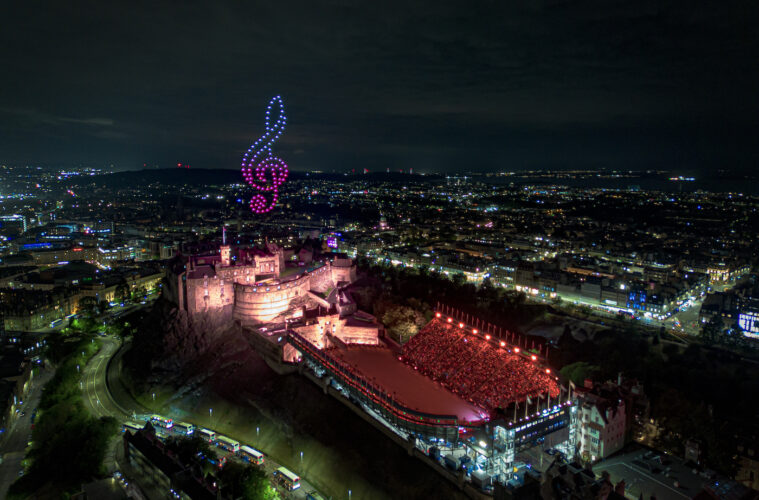
AeroAVA is a well-established provider of choreographed drone shows for major outdoor events including the Royal Edinburgh Military Tattoo.
AeroAVA MD Tom Rees says the complexity and scale of the drone shows can vary widely: “Smaller events might use around 100 drones, while major city-wide shows can run into the thousands, all flying pre-mapped routes with strict safety margins.”
The dramatic growth of the drone show market has been highlighted by the likes of Grand View Research, which valued the sector at $1.56 billion (£1.19bn) in 2024, and predicts it will reach $6.11bn (£4.57bn) by 2033.
Key to the increasing complexity and popularity of aerial shows in recent years is the innovative technology that powers them. With the rise of AI, precision navigation systems, advanced connectivity, and the latest image-mapping and LED technology, aerial displays are using state-of-the-art tools to create eye-catching and complex performances.
“We’ve got centimetre-level accuracy.”
Drone technology company Celestial works on numerous major events including London’s New Year’s Eve celebrations. Its head of sales and marketing Ottilie Culloty says the delivery of such spectacular displays is driven by precision technology and the LED lights enabling almost endless combinations of colours: “We’ve got centimetre-level accuracy to ensure the drones’ positions in airspace. This is enabled by global navigation satellite systems, which continuously correct each drone’s position in real time.”
She says hardware improvements have transformed the scale and ambition of drone shows in recent years: “We’re able to fly longer and quicker due to advances in battery life and energy efficiency; it also allows us to have much more ambitious and high-speed choreography in shows.”
At AeroAVA, Rees says cutting-edge technology is being used to expand the reach, and audience, of the shows: “We have a phone app that means audiences in the wider community can hear the show. They might be able to see it two or three kilometres away but not hear it, so they download the app and get the audio on their phones.”
These new technologies and innovative approaches are the driving force behind the rise of aerial spectacles enabling eye-catching and complex performances but rather than replacing fireworks events and suppliers are looking to combine the best of both.
From its base in Daventry, DroneSwarm has worked on a wide range of events from live shows such as Classic Ibiza at Burghley House to Queen Elizabeth’s Platinum Jubilee and St. Patrick’s Day celebrations. Its director Mat Lawrence says technology enabling the combination of pyrotechnics and drones, known as pyro drones, is producing dramatic results: “This innovation creates a unique show that combines coordinated drone movements with synchronised fireworks in a single display.
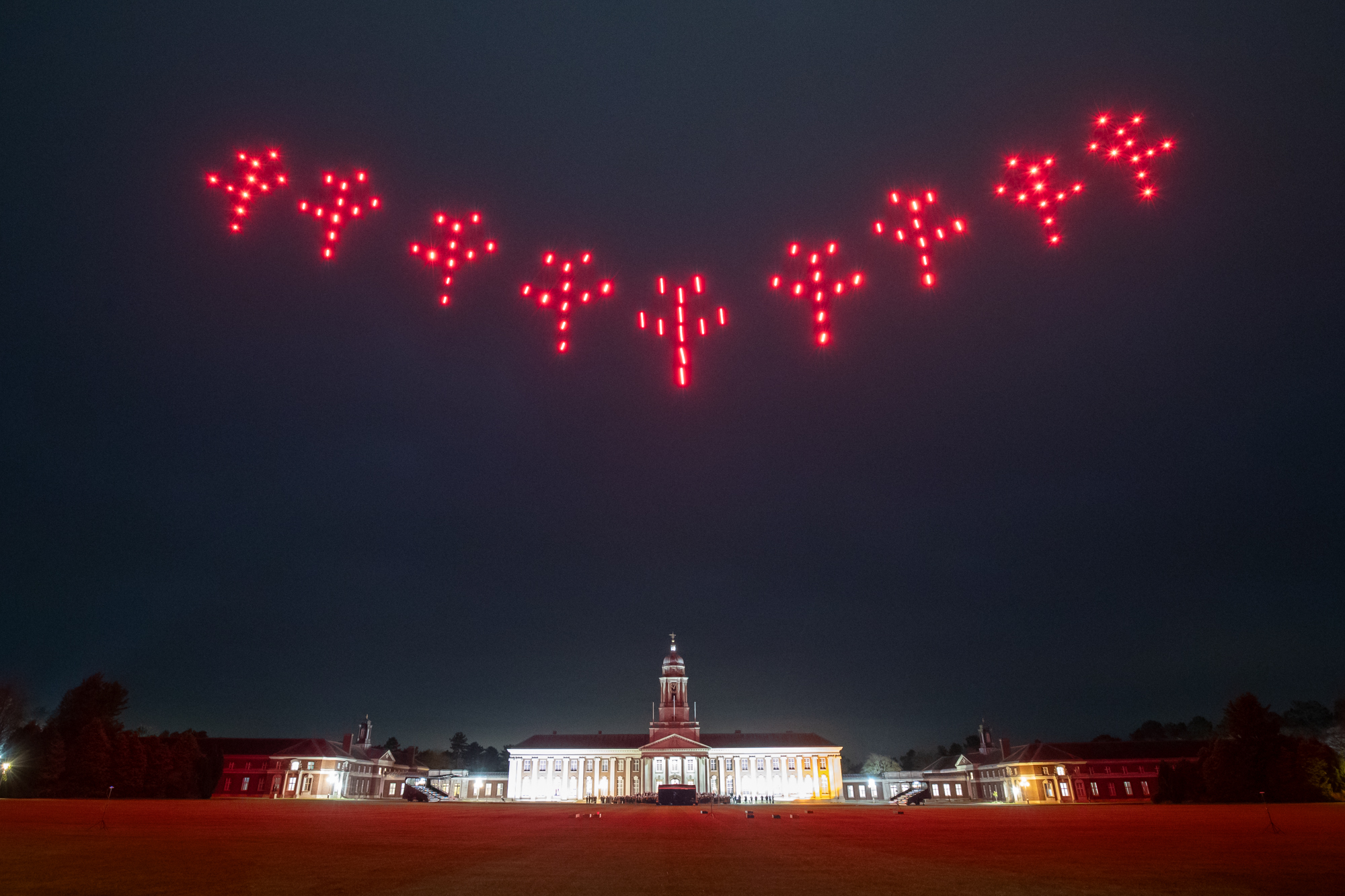
DroneSwarm display at the Royal Military Acadmey
A safe flight
In Liuyang, China, last year, every aerial spectacular organiser’s worst nightmare came true. The city staged what was meant to be an eye-catching drone display, but a malfunction turned it into something closer to an apocalyptic scene than a celebration.
Huge fires engulfed Liuyang’s Sky Theatre, the location of the show, with reports describing people using umbrellas to shield themselves from falling debris while others ran for safety. With footage of the incident having been shared widely on social media, many are asking whether it could happen again, and whether drone shows truly safe.
Culloty explains how Celestial ensures that its shows are safe, and reveals the technology involved: “We have automated anti-collision algorithms, which is specialised software that automatically calculates the flight path of each of the drones. It’s essential that they maintain a safe distance from each other and from the geofence that we have in place.
“High-safety drones now feature multiple independent navigation sensors and estimators to ensure that the position accuracy is as it should be, and that there’s a fail-safe in case it’s not.”
Technology is only playing a part in keeping aerial displays safe in the UK, there are also strict rules and regulations in place. Permission from the Civil Aviation Authority (CAA) is required for anyone operating drones, light shows, or fireworks, as the displays can distract or endanger aircraft. DroneSwarm’s Lawrence says the CAA’s rules are some of the strictest in the world.
Culloty describes Celestial’s drone show permit and audit process: “We’ve got a really good relationship with the CAA, and the Federal Aviation Administration in the US, so we have to ensure we obtain all the necessary permits and waivers for every show and that we have regular audits to ensure that we’re compliant.”
With regulations varying significantly from country to country, it means places with less stringent oversight are more susceptible to accidents than regions such as the UK. Rees notes that differing regulations “affect everything” from the location of launch and landing zones to overflight rules.
He uses the Middle East as an example. “Because the rules differ so much, especially in places like the Gulf states, we carry out a regulatory assessment at the start of every project,” he says. “That gives us a clear picture of what’s allowed and what procedures we need to follow.”
A question of sustainability
Research increasingly highlights the environmental impact of fireworks, which can leave behind debris containing heavy metals and release large amounts of CO₂. As the demand for sustainable events grows, organisers and suppliers are seeking ways to create memorable moments while minimising environmental harm. Drone shows rely on electric batteries and LED lighting. They are quiet and because they do not produce debris they are far less disruptive to wildlife and air quality than fireworks.
Rees says, “There is going to need to be further investigation into how much more sustainable and environmentally friendly a drone show is because they use LiPo batteries.”
Lawrence says the sustainability advantages of drone shows over firework displays is negligible and that for DroneSwarm the integration of drones with its firework displays is for the added visual spectacle rather than for sustainability reasons.
Drone shows are certainly a more sustainable alternative than pyro but with the sector still relatively new, more research needed to establish whether it is truly a sustainable alternative.
Flights for the future
With state-of-the-art technology providing an exhilarating and ever-evolving alternative to traditional pyro shows, the projected growth of the drone display sector is understandable. Even so, Culloty predicts there won’t be a total replacement of fireworks, but rather an increasing integration between the two.
“One of our recent shows was with Alexandra Palace,” she says. “We did the Fireworks Festival, which is now called the Fireworks & Drone Festival because of our partnership.”
This perspective is shared by Lawrence, who says drones will, and do, complement fireworks rather than displace them entirely, and adds that fireworks remain a cheaper alternative to drones.
Rees say that as the market evolves, he expects the continued rise of drone-driven light shows to be tied to their use to enhance an existing live event rather than being stand-alone displays: “The future of drone displays in their own right will need to evolve. A drone show as the show itself is a very expensive offering. They need to be part of a holistic experience.”
Lawrence provides a similar view, suggesting that the use of drone shows to complement an existing event is not only more sustainable but also safer from a planning perspective; in that if an event is struck by bad weather not all forms of entertainment will have to be cancelled.
Culloty says organisers of live events of all types are beginning to embrace drone technology, with concert promoters and performers in particular showing strong interest: “We’re seeing a trend with musicians wanting drones as part of their live music performance.”
Whether used as standalone attractions or to complement existing live shows, drone displays are now firmly part of the live entertainment ecosystem. With rapid technological innovation and a growing appetite for visually striking aerial spectacles, drone and light shows are well on their way to becoming a ubiquitous element of modern live experiences.