

 Christopher Barrett
Danny Bell, Goldenvoice’s SVP of talent, launched the Portola festival in San Francisco in the aftermath of the Covid pandemic. He discusses how the festival’s unique identity, inspired by historical events and focused on a specific audience demographic, has contributed to its success.
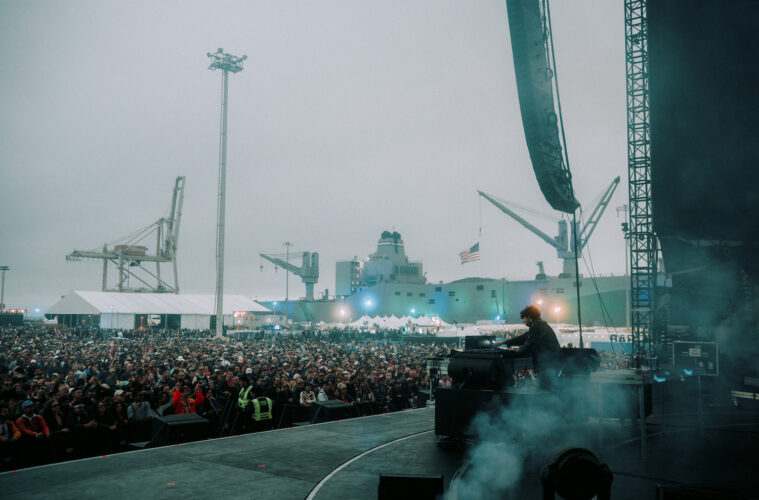
Due to take place on 20–21 September against the remarkable industrial backdrop of San Francisco’s Pier 80, the 45,000-capacity Portola festival involves four stages featuring fresh talent alongside some of the most established names in electronic music, including The Chemical Brothers, LCD Soundsystem, The Prodigy and Moby.
Aware of the need to create a festival that has a very clear identity and audience demographic to succeed in a challenging festival market, Danny Bell is clearly laser focused not only on Portola’s production aesthetic and artist booking policy but also limiting the event to an adult audience.
 What inspired you to launch Portola?
Portola started in 2022. It takes place in San Francisco at Pier 80, which is a massive active maritime shipping pier. The concept is a 21-plus dance music festival for poeple who have been fans of dance music for over a decade now, as well as the new fans whose taste has not really been served by the rest of the festivals in the US.
[Gaspar de] Portola was a Spanish explorer who found California, and his name is used on many streets and neighbourhoods all over California. When I was figuring out the name of the festival, we were coming right out of Covid and I was doing research. I found out that there was a festival called The Portola Festival of 1909 in San Francisco, and that festival was an event produced by the city after it was reopened for business following the earthquake and fires of 1906. I thought that was a great story and a great tie in, because I was creating a new festival in San Francisco right after Covid.How has your Portola festival evolved, and are there any changes in store for the fourth edition?
The show is really focused on the music; music is the experience. I try to overly stack the bill. We have four stages running simultaneously all day, so there’s something for everyone at all times. All the stages are fairly close to each other, but they all have a very unique environment. We look to improve each stage as much as we can each year. For example, the Warehouse Stage, which is one of the things that makes the venue very unique – a 300,000 square foot warehouse with 30 foot ceilings – is an amazing space. It takes some time to make sure the production and the sound in a space that big is great. We’ve identified a few sound issues in there to fix for this year. The Crane Stage, which is our second stage, has been surrounded by sea containers and that helps create more of a vibe with the production but it also helps with sound bleed between stages. Then there is our ever-long quest to find places for people to sit down on a wide-open asphalt pier. That is the next thing that we are planning to tackle. We have definitely made improvements over the years, but there’s still a way to go.
“To have a successful festival launch now you have to have a point of view; to be saying something.”
Who are the key players in the Portola festival production team?
Our in-house production team at Goldenvoice is great. They’re work with a myriad of different vendors and people who really contribute to the show. The number one guy, I personally love because I’m a sound nerd, is Dave Rat of Rat Sound Systems in LA. We brought Dave in to do full sound design for the festival site and all four stages. He’s an absolute wizard, and it’s a blast really getting to work with him to try to dial in all the sound, not only on site, but to make sure it doesn’t go too far and disturb the neighbours. We spent weeks and months on models and speaker placements in order to have the best sound for the people onsite without it going much further. That’s a real key component. I’ve also worked with Steve Lieberman from SJ lighting on lighting design. I’ve been working with him for a long time and he has never made me a bad design. He’s a great guy. Then, we have Imogene Strauss, who’s our creative director. She is the creative director for Charli XCX. She’s a friend of mine from college. I brought her on for the first Portola, and she got it right away. Imogene’s done all of our visual art, but this year is going to be the beginning of us working with her on some stage design.
What’s behind your decision to limit the festival to fans aged 21 and over?
In the US, most festivals are open to all ages, or 18-plus, but 21-plus is rare. Once people turn 21 in the US there’s a behavioural switch that turns on for some reason. So, a 21-plus festival does create a calmer, more adult, environment. I took a trip to Europe in 2016 and that trip really started the inspiration for Portola. One of the things I really noticed, when I went to Sónar and Ibiza, was that people were dressed in t-shirts and jeans, and they were adults. Meanwhile, in the US at the time everyone was dressing up in these silly costumes, and it wasn’t as focused on the music. At Portola there’s a lot of people dressed in everyday clothing, people are there to party and express themselves but music is the key element. The 21-plus aspect is definitely a large contributing factor to that.
In the UK we have seen a string of festival closers, partly driven by a sharp hike in production costs. Are you seeing that in the US?
Yes. I’ve been producing festivals for 15 years in the US, and I’ve produced about 30 festivals for other people before I did my own. One of the key reasons I wanted to do my own festival was to create one with a very strong identity and concept. It is a business decision because in order to have a successful festival launch now, you have to have a point of view, you have to be saying something, you have to attract a certain crowd and build the sense of community. That’s a prerequisite of any successful festival, and that’s why I really love Goldenvoice – all of our festivals have a clear identity. I just went to our Cruel World festival in LA, which is an ‘80s goth festival. It blew me away being there and seeing the amount of people in their 40s, 50s and 60s, dressed up like they were in high school and having the time of their lives for a day. It’s a show with a very specific point of view and audience, and it’s a very special thing, and that’s what I’m trying to do with Portola.
When it comes to programming the event how challenging is it to successfully track and react to new trends in electronic music consumption?
It’s extremely difficult. The thing that really excited me three years ago was this new wave of producers and fans who were more interested in getting sweaty in the warehouse than they were going to a club. Artists that came out of that generation wave, including Sammy Virji, Kettama and Interplanetary Criminal are very cool. There was explosive growth for a couple years. Those waves of explosive growth happen in every genre, especially in electronic, every few years and that makes it difficult trying to identify what’s next and what people are into. Now is a really interesting time, pop is dominating. Look at the Glastonbury headliners like Olivia Rodrigo, Gracie Abrams, Lewis Capaldi and Lorde, it’s really interesting just how big pop is right now. Look at what Charli XCX just did on this last campaign; she had a massive set at Glastonbury and Coachella. She’s the one right now. She’s so big, the influence she’s having is huge – it has changed the musical landscape, at least for the next 12 to 18 months. We’re really feeling that in the electronic music scene, where instead of the next wave of people breaking like Sammy Virji we’re seeing these pop acts in the ‘Charliverse’ really taking over the moment. It’s awesome but not something you can predict.
The festival site is around a million square-feet, do you have any ambition to grow the event beyond the current 45,000 capacity?
I don’t want to expand much more. There is room to if we would like to, but we would want to talk about ways to change the flow and stage orientation if we do end up expanding. I am a fan of the four-stage setup we have right now, and that audience capacity because it’s comfortable. You’re never in a situation where you feel crowded. Everyone can get into every stage at all times and I think that’s really important. I like the size we are at right now, but you never know what the future will bring.