

 Christopher Barrett
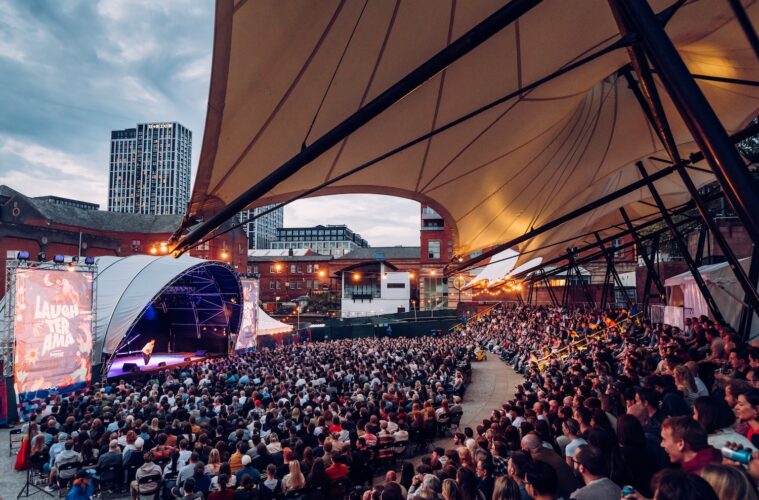
Led by sibling duo Will Briggs and Cass Randolph, 57 sees around 100,000 tickets sold for its comedy festivals each year. Among the events it programmes, manages and promotes are the Greenwich Comedy Festival at the Old Royal Naval College, Bristol Comedy Garden and Brighton Comedy Garden. Here, Cass charts her comedy-filled career path.
 What was the first major live event that you attended, and did it have a lasting impact?
Absolutely. My mum first took me to Glastonbury in 1990. I was seven and my brother Will was ten. I vividly remember watching Jesus Jones on the Pyramid Stage and later falling asleep in the imprint of a tractor tyre. It felt like another world.
Mum was a huge believer in the value of live experiences. Every year she’d battle with our headteacher to get us time off school, arguing that we’d learn more in a weekend at Glastonbury than we would in a year in the classroom.
Later, after she married Malcolm Hardee, who ran the infamous Up The Creek comedy club in south-east London, we’d spend Glastonbury camped backstage at the Comedy Tent. The performers, the characters and the complete unpredictability of it all contributed to a pretty unique upbringing.
What led to your first role in live comedy production?
I was working in the music industry on large-scale awards shows, while Will was building a reputation in comedy promotion through the acclaimed Sunday Special nights at Up The Creek.
He came through alongside a generation of comics who are now household names — Josh Widdicombe, Tim Key, John Robins, Sara Pascoe and many more.
Every year we’d religiously go to as many music festivals as possible, as well as the Edinburgh Fringe. During the summer of 2008 we realised how strange it was that London, arguably the capital of stand-up comedy, didn’t have anything to compare. So, we set about changing that. We wanted to capture the spirit of a music festival with the electric energy of a comedy club, and we launched Greenwich Comedy Festival the following year.
Did comedy play an important part in your childhood?
Hugely. Thanks to Malcolm, we spent most weekends at Up The Creek. We worked behind the bar, heckled the open spots, emptied our pockets into the fruit machines and generally lived at the venue. I even had a brief stint DJing there.
It became our second home. Beyond the club itself, Malcolm was constantly surrounded by comedians, artists, writers and wonderfully eccentric characters. There was always somebody interesting coming through the house.
At the time it just felt normal. Looking back, we realise how unusual and influential that environment was. It gave us an early appreciation of live entertainment and the communities that form around it.
“I’d like to think our success comes from some strange sibling alchemy.”
Are there challenges involved in working with a sibling?
I think anyone with a sibling already knows the answer to that.
It’s definitely a unique dynamic. We can disagree spectacularly, often over the smallest details, but there’s also a level of trust and honesty that would be difficult to replicate elsewhere.
I’d like to think our success comes from some strange sibling alchemy — years of shared experiences, instincts and understanding. Naturally, Will would disagree and claim it’s entirely down to his flawless programming.
The reality is probably somewhere in the middle. We have different strengths, different perspectives and a healthy willingness to challenge each other. That’s often where the best ideas come from.
You’ve produced many impressive outdoor shows at 57, not least bringing Greenwich Comedy Festival to life during the pandemic. What was the most challenging project you’ve delivered?
2020 wins by a mile. We’d already cancelled festivals in Bristol and Brighton, but there was still a possibility that Greenwich Comedy Festival could happen in September. What followed was months of constant adaptation. We reimagined layouts, rewrote plans, revised capacities, created socially distanced audience formats and reacted to changing regulations almost daily. We must have typed the words “socially distanced” more times than any humans should.
Despite the challenges, it became one of the most rewarding things we’ve ever done. Everyone involved — our incredible team, performers, suppliers and audiences — recognised how important those shows were. After months without live entertainment, it felt less like a festival and more like a public service.
“Nimble” was the industry buzzword that year. Personally, I think “deranged” was a more accurate description of how it felt.
What’s the first career highlight that comes to mind?
The first Greenwich Comedy Festival, without question.
At that stage it was essentially just Will and me trying to build a festival from scratch. Planning the event by day and out flyering commuters at stations every night.
There was nothing glamorous about it, but we pulled it off. Every show sold out, audiences were buzzing and performers loved the atmosphere.
From day one, our ambition was to take the energy and intimacy of a great comedy club and scale it into a festival experience. We genuinely felt we’d created something different.
Each year we refined the format, improved the experience and learned more about what audiences wanted. Many of the people who attended that first year are still coming back today.
Once we felt we’d cracked the model, we began expanding nationally. Bristol came first and remains one of our favourite cities. Since then we’ve grown into Brighton, St Albans, Manchester, Cambridge and now Norwich, alongside an incredibly exciting new run of shows in the iconic Courtyard at Somerset House.
How is your summer events season shaping up, and what are the key projects?
It’s shaping up to be one of our biggest summers yet.
Alongside all our established locations, we’re launching a beautiful new site in Norwich’s Chapelfield Gardens as part of our Comedy Garden series.
The major headline this year is Somerset House. It’s an extraordinary setting and we’re bringing together a huge line-up of the country’s most exciting comedians.
It’s exactly the sort of project we love — taking world-class comedy and presenting it in a spectacular environment.
Who or what has played the biggest role in supporting your career progression or inspiring you?
Malcolm Hardee is the obvious answer. He introduced both of us to this world and gave us a front-row seat to live entertainment from an early age.
Equally, our mum deserves enormous credit. She was always charging headfirst towards adventure, creativity and live experiences. Together they created an environment where putting on festivals, events and shows never felt intimidating.
For many people, producing an outdoor festival might seem daunting. For us, it simply feels like home.
If you could change one thing about the events industry overnight, what would it be?
We’d happily welcome back the temporary 5% VAT rate that existed during the pandemic.
Beyond that, we’d love to see more investment from local authorities into parks and city-centre spaces that can support cultural events. We work hard to make our festivals as lightweight and efficient as possible, but access to infrastructure such as power and event-ready facilities can make an enormous difference.
The easier it is to stage great events, the more vibrant and culturally rich our towns and cities become.
What is your favourite way to unwind?
I’m sorry, I don’t understand the question.
At this stage of the year, the concept of unwinding feels entirely theoretical. With eight locations operating this summer and plenty more ideas in development, there’s always something demanding attention.
One of the great things about building a business is that the momentum never really stops. Unfortunately, neither does the responsibility.
That said, autumn provides a chance to reflect and reset. This year we’re expecting to welcome more than 100,000 people across our festivals. Once the dust settles and we’ve had a chance to take stock, I’m sure we’ll find a moment to appreciate how far we’ve come.
This article features in the summer edition of Access All Areas magazine – read it here.