

 Christopher Barrett
From brand activations to family exhibitions, theatrical presentations to festivals, AAA explores the fast-evolving world of immersive events.
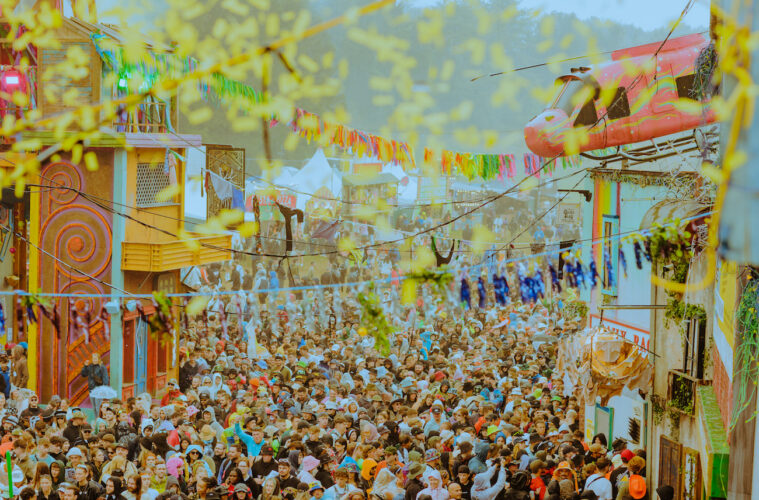
Since the outset, Boomtown Fair has intertwined storytelling, escapism, theatricality and community engagement with live entertainment. The event, which recently saw plans to increase its capacity from 66,000 to 77,000 approved, has once again sold out well in advance.
With 12 main stages, and more than 50 ‘hidden venues’, along with thousands of performers, Boomtown will take place at its longtime home of Matterley Estate, Hampshire, from August 10-15. Among the diverse array of acts set to perform are Maribou State, Sex Pistols and Sean Paul.
Luke Mitchell
Boomtown co-founder and creative director Luke Mitchell says it is nearly two decades since he first had the idea of creating a ‘parallel world’ in a field. Boomtown is divided into themed districts, each with a unique design, stages, characters and experiences that encourage attendees to explore different worlds and ways of living. Each edition of the festival involves a central narrative that unfolds throughout the event, culminating in the closing ceremony.
It has proven a hugely popular and complex concept, that involves one of the biggest and longest builds in the festival industry.
Mitchell says that the look, feel and delivery of the event are all based around storytelling: “When we launched the event we very quickly started to recognise the power of the storytelling that sits underneath it, and so we brought the story creation forward so that it would be written before we looked at the production design, the shape of the festival, and then everything could then come off the top of that and be really cohesive and in tune with that story. Storytelling is the biggest factor in the creation of a really stand-out, truly immersive, event.”
Understandably, Mitchell is a little frustrated by how loosely the term immersive is now being used to describe events of widely varying format and quality.
“Immersive is being used all the time and to describe absolutely anything,” he says. “Where the term stands up more is when visitors are taken into the depths of a story, which swims underneath everything, with real cohesive through-themes and values embedded in them.”
“Storytelling is the biggest factor in the creation of a really stand-out, truly immersive, event.” – Boomtown co-founder Luke Mitchell
Wake The Tiger
On the back of a successful crowdfunding campaign, Wake The Tiger was launched by the team behind Boomtown Fair in July 2022 at the festival’s Bristol HQ. Described as an ‘amazement park’, the immersive experience initially covered 1,000 square meters and involved 15 rooms but on the back of strong ticket sales the attraction has since been doubled in size.
With an annual attendance of around 170,000, Wake The Tiger has proven a huge success, and plans are afoot to open a second park in another major UK city.
Wake The Tiger managing director Graham MacVoy say that when he sat down with Mitchell to formulate initial plans for the event experience, there was a reluctance to use the term immersive: “When we first started we were against using the word immersive because it was so overused and its meaning had become so diluted, but ultimately we needed to use a term the general public would understand.
“When a truly immersive event really works is when you create a real connection between the environment that’s around you and your sensations and feelings. Boomtown creates that at a level beyond almost any other event because of the connection to the music and the storytelling is so engaging. Wake The Tiger is very different because we don’t have the wow factor of the music, but we still take the storytelling, the engagement and the values, and try to connect with people through it. If you can achieve that, then you successfully create a truly immersive experience.”
Live Odyssey
 London’s Camden Town has long been synonymous with live music, having been deeply entwined with the emergence and evolution of scenes such as punk and indie music while being the home of artists such as Amy Winehouse. With the aim of celebrating the North London borough’s long relationship with counterculture and music, new immersive experience Live Odyssey was opened there this month.
A live music experience spanning seven rooms, each representing a different musical era, Live Odyssey has been designed with the aim of immersing music fans in British music history – from the 1960s up to the present. Located in Camden Market at the top of steps where The Clash posed for the cover of their debut album in 1977, a key element of the immersive attraction is its Hologram Room featuring holographic performances by British artists. First to feature is The Libertines.
Live Odyssey also involves a live music room and bar, hologram ‘boxes’, rare live footage and photography from the UK music scene, along with heritage items relating to artists including David Bowie and John Lennon. Other key elements include a rotating collection of 3,500 original album and single cover artworks and live art installations.
“We wanted to create a Bum Bum Train-style journey mixed with live performance and cutting-edge technology.” – Gary Prosser
Live Odyssey creative director Gary Prosser says the inspiration for the project came when he and its co-founder Rich Taylor drove past Madame Tussauds and saw a huge queue snaking down the road outside.
“We thought we should take that idea, make it about live music and gave it the justice it deserves by using our musical background and knowledge to create an experience that really typifies the British music experience over the last 60 years,” says Prosser.
He says the aim was to create an experience that was both educational and immersive, and that leant on physical and technology-backed creative environments. Aside from Madame Tussauds, Prosser says other influences include the cult immersive theatrical experience series You Me Bum Bum Train.
“We’re telling the story of the early life of John Lennon, in partnership with his sister Julia Baird, which involves his family experiences and early life in Liverpool,” he says. “We have recreated his bedroom, using images that we have from Julia, from when he was 15 years old and first met Paul McCartney. We wanted to create a Bum Bum Train-style journey mixed with live performance and cutting-edge technology.”
Live Odyssey’s venue has been awarded a live music license and includes two 150-capacity performance spaces. Supporting grassroots talent has been a key consideration from the outset, says Prosser: “We’ve created a tourist attraction that can also be utilised as a live music venue. It will not only provide a space for talent to perform but 50% of Live Odyssey’s ticket price will be donated to the Music Venues Trust charity, potentially raising £200,000 for it annually.”

NEON at Battersea Power Station
Building popularity
The construction of dedicated immersive event venues is one of the most obvious indications of just how big the sector has become.
Stretching a kilometre along Excel London’s waterfront, Immerse LDN is part of Excel London’s £300m regeneration programme, with the venue expected to attract more than 2.5m visitors annually. Purpose-built to host immersive consumer-facing exhibitions, the venue has accommodated shows including Jurassic World: The Exhibition, The FRIENDS Experience: The One in London, and The Formula 1 Exhibition. The latter has become the venue’s most successful and longest-running event, with 340,000 tickets sold.
The ongoing redevelopment of Battersea Power Station has seen the opening of another purpose-built immersive entertainment venue by global entertainment group NEON, which is responsible for touring shows including Machu Picchu, the Golden Empires of Peru.
With floor space of more than 3,200-square-metres, NEON made its debut this month with the opening of the Jurassic World: The Experience. It is expected to host two immersive family entertainment shows per year.
The Expo Pavilion Group led the creative design of the venue and its distinctive façade, working alongside construction and property consultancy Gardiner & Theobald. Star Live was the principal contractor and oversaw design engineering for the new experiential exhibition centre.
NEON has been designed for ‘meanwhile use’, which means there is the option to disassemble and relocate the structure in the future. Sustainability has been a key consideration in the venue’s design, enabling the modular structure to be disassembled with 95% of materials recoverable for re-use. Star Live’s role involved the installation of a 128-tonne roof structure, with 235mm insulated steel-clad panels, that had to at assembled at ground level before lifting it into places using 48 synchronised chain hoists.
“We look forward to bringing our world-renowned immersive experiences to Battersea Power Station, which has quickly established itself as a vibrant centre of creativity and community since the restored Power Station opened its doors,” says NEON CEO Ron Tan.

Enter the Storehouse
Sage & Jester, a newly launched arts production company, is kicking off with an impressive debut project; a large-scale immersive theatre show encompassing the 9,000 square metre Deptford Storehouse in London.
The Storehouse event, which opens on 4 June, is set to run until September. Set across a space equivalent to two football fields, the show takes audience members into a world where humanity’s stories have been carefully archived since 1983 – the dawn of the internet – and where they will be engaged in a battle between the defenders of truth and creators of fake news.
Sage & Jester consists of a 40-person team who collectively have worked for the likes of Secret Cinema, Punchdrunk, BBC Studios, Warner Music and Vice Media. Among the key members of the Storehouse production team is executive producer and AAA 100 member Zoe Snow; whose previous projects include the Birmingham 2022 ceremonies. Other members of the team include lead producer Rosalyn Newbery, production designer Alice Helps (Lost Origin), costume designer Julie Belinda Landau (Secret Cinema) and lighting designer Ben Donoghue (Ezra Collective’s UK Tour).
“A new word is needed to really describe truly immersive experiences.” – Susan Walker
Production house Scene2 has been the design and production partner for Storehouse. The company, co-founded by Susan Walker and Andy Dixon, has been engaged in the design and building of immersive events for more than 25 years.
Walker says major immersive theatrical experiences are a great way of commercialising empty spaces, and that more often than not the event producers find a space first, and then design and build an event experience that fits into it.
In the case of the enormous Storehouse project, she says it involves a bespoke structure created within the warehouse using around 4 km of timber, and involving 20 carpenters working daily. It is the largest immersive experience environment Scene2 has built since the company was founded in 1999.
“We’re used to doing immersive experiences with brands, or immersive theatre with existing IP, where there’s always an existing story or brand book that goes with it, so you always have something to reference back to,” says Walker. “The beauty of this project, and what really attracted us to it, is that it is moving into a different arena. It is taking an immersive theatrical experience into a very artistic space. We are working with an artist who has a message, and it’s our role to build a vehicle to facilitate that.”
Walker says that in order to maximise the potential of an immersive event experience, production companies should be brought in as early as possible and work collaboratively from the outset: “The best result are achieved when all the creatives, including directors, writers, sound designers, lighting designers, set fabricators and set designers are all working together on the concept from the beginning. That enables you to be more creative, really push boundaries, and be better with the budget. One of the issues we face is when we are brought in as just fabricators at the very end of the process when the designs have been finished and we’re given a set of drawings to build to. Often they are unrealistic, and you spend months and months redesigning the project.
Much like others who have been creating immersive events for years, Walker is a little frustrated by what she sees as the increasingly frequent misleading use of terms such as immersive and experiential, which have become buzz words in recent years.
“That is why this project is such a positive move forward, it’s true to the real meaning of immersive,” she says. “Sage & Jester have created an immersive world that people enter into and become affected by it, the experience informs them and changes the way they feel. I think a new word is needed to really describe truly immersive experiences.”
For the full article see the Summer edition of Access All Areas here.