

 Christopher Barrett
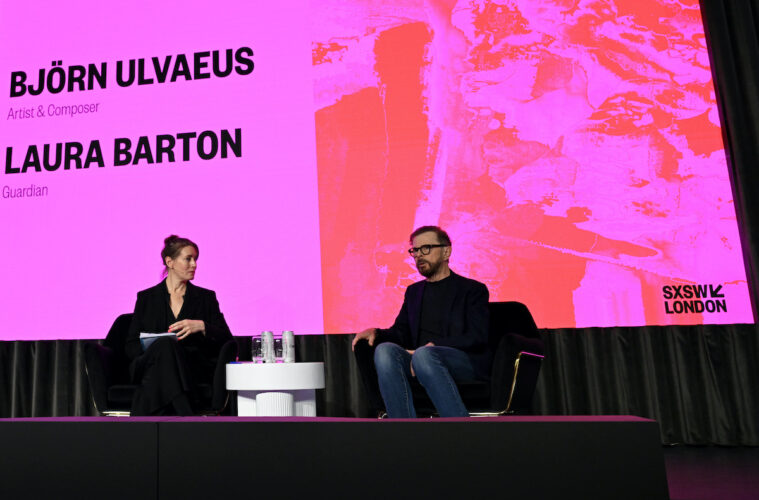
ABBA member and Pophouse Entertainment founder Björn Ulvaeus took to the stage at the first SXSW London yesterday, 5 June, to discuss topics ranging from creating ABBA Voyage to his co-writing a new musical with AI.
Speaking on stage in front of a huge audience that had patiently queued around the block in advance of the session at East London’s The Truman Brewery, the Swedish singer, songwriter, producer and president of the International Confederation of Societies of Authors and Composers (CISAC) outlined how he had embraced new technology throughout his career.
Ulvaeus said that his ABBA partner Benny Andersson had owned one of the first synthesisers, a Minimoog, and the band had been among the first to have digital equipment in the studio. “We always wanted the latest [technology]. That’s how it was then and that’s how it continues,” he said.
Under the banner The Future of Entertainment, 80-year-old Ulvaeus told The Guardian journalist Laura Barton that he sees Pophouse Entertainment as being a creative hub for the artists whose music catalogues it had acquired. They include KISS, Cyndi Lauper and Avicii.
Pophouse, a leading investor in ABBA Voyage, has previously announced that it is following up the hugely successful show that has involved the work of countless industry contributors including ES Global, Solotech and Stufish Entertainment Architects.
“We believe KISS could be a very interesting avatar experience in the kind of Marvel universe,” said Ulvaeus. “They were cartoons and now have transcended to the digital world.”
Ulvaeus said he is three-quarters of the way through writing a new musical that he is working on using AI songwriting tools.
While he admitted that AI is “lousy at writing a whole song” and is “very bad at lyrics” he said it was very helpful with ideas and the results are quicker than when working with a fellow songwriter: “It’s fantastic. It is such a great tool. It is like having another songwriter in the room with a huge reference frame. It is really an extension of your mind. You have access to things that you didn’t think of before.”
Many leading music industry executives, and hundreds of artists, have lobbied the government extensively to implement protection measures to safeguard artists’ IP from being exploited via AI. Ulveaus said he was optimistic of a positive outcome for creators.
“AI models wouldn’t exist without our IP,” he said. He predicted that the music industry will come to an agreement with the tech industry to renumerate artists, and suggested the model could be similar to that used by streaming platforms such as Spotify.
“I think the model that is closest is the model that we have in streaming services where they have you subscribe, and part of the subscription goes back to the music industry,” he said. “That one might be the one that applies to this as well, but AI is something completely different, so we don’t know.”