

 Access All Areas
AEG Europe vice president of sport Gael Caselli says the company’s combined focus on sport and live entertainment means it has played an integral role in the rise of ‘sportainment’. Here, Caselli provides his perspective on why the merging of sport and live entertainment has become such big business.
Fan engagement in sport is evolving fast, with more events tapping into live entertainment to deliver unforgettable experiences. As a leader in the evolving relationship between sport and live entertainment, AEG has the privilege of sitting at the unique intersection where sports and live collide. 2024 was a significant year for us, with global events driving momentum across the industry – from the Olympic and Paralympic Games in Paris, Euroleague Final Four and Laver Cup in Berlin, and the League of Legends World Championship in Paris and London – and 2025 is already shaping up to be another transformative year.
We’re seeing the transformation of ‘sportainment’ firsthand at AEG, actively leading in its development at our venues, as we host more immersive sporting events, and seeing an increased number of collaborations with renowned global sporting franchises. These are unique opportunities to turn supporters into even more active and engaged participants, both in person and online, bringing them even closer to the action. After all, most sporting events often only last a limited time – 90mins for football, or 40 to 48mins for basketball – therefore it’s increasingly important for sports to explore new ways to extend the excitement, create lasting connections, and enrich the fan experience beyond the game itself.
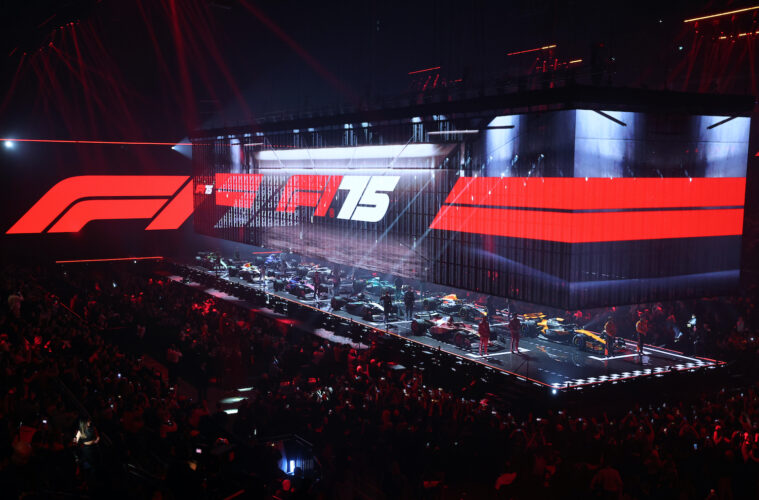
Take F1 75 Live that was recently held at The O2 in London (pictured). As an industry first event that generated millions of views, it further demonstrates that Formula 1 is no longer a form of entertainment that only exists on the track. Combining live performances with appearances from motorsports stars, the event celebrated the heritage of Formula 1 and demonstrated the global influence of motorsport beyond traditional fan engagement, all whilst ‘driving’ momentum for both the sports and live industries.
Whilst this event was new for this year, other sporting events have been setting the bar for immersive fan experiences for a little while. An example of this was last year’s Laver Cup – hosted across Berlin’s Uber Arena, Uber Eats Music Hall, and Uber Platz. The event expanded its offering with training courts where fans could watch top athletes up close, fan zones to socialise and enjoy tennis-related entertainment, and a Hall of Fame exhibit showcasing the sport’s legendary moments. Similarly, the NBA Paris Games brought an exciting buzz to the city in a multitude of ways to connect fans with the action. These events all have one thing in common – they offer fans a new experience and increase value when going to see their favourite sports play out.
This is also a trend that is gaining more momentum across the industry. With over 133 million viewers tuning in for this year’s NFL Super Bowl Halftime Show, FIFA is looking to replicate this success, with the recent announcement of a halftime show at the 2026 World Cup in New York. The beautiful game has seen the inclusion of live entertainment more and more in global broadcasts events in recent times, with the likes of Lenny Kravitz’s performance at the 2024 UEFA Champions League Final Kick Off Show at Wembley Stadium.
Sporting events play a huge part in the UK’s ‘experience economy’ – an industry that employs an estimated three million people, and the Centre for Economics & Business Research predicts it to reach an estimated contribution of £146bn by 2027. The impact of live entertainment, with its global reach and ability to unite fans, will continue to inspire the development of engaging new experiences for sports fans beyond the pitch, track, and courts, creating global moments of excitement, connection, and buzz around major sporting events.
But it’s always a fine balance – sports fans have always been deeply passionate, and any new experience needs to feel authentic. I’m excited to see how companies, such as FIFA, tread the line of creating new cultural moments that garner attention and new offerings, whilst enhancing the connection they already have with the game.
-
- League of Legends World Championship 2024 opening ceremony. Image- Luke Dyson
-

- Laver Cup. Photo – Pedro Becerra STAGEVIEW
-

- League of Legends World Championship 2024 opening ceremony. Image – Luke Dyson