


 Christopher Barrett
Andrew Lansley provides an update on the progress and impact of the Green Events Code of Practice (GECOP) pilot project, launched last year, involving ten local authorities and 60 events.
A set of guidelines and standards designed to help event organisers minimise their environmental impact by implementing sustainable practices across various aspects of event planning, including energy usage, waste management, transportation, food sourcing, and overall event operations, GECOP is garnering interest way beyond the initial ten local authorities and 60 events that have used it.
Developed by industry sustainability campaign groups Vision for Event Sustainability and Julie’s Bicycle, and launched at the Event Production Show in 2022, the main aim of the code is to commit to a minimum of 50% reduction of greenhouse gas emissions by 2030, with specific targets set including a 50% reduction in fossil fuel consumption at live events by 2025; a reduction of at least 30% in meat and dairy consumption onsite by 2030; and to eliminate single-use plastic by 2025.
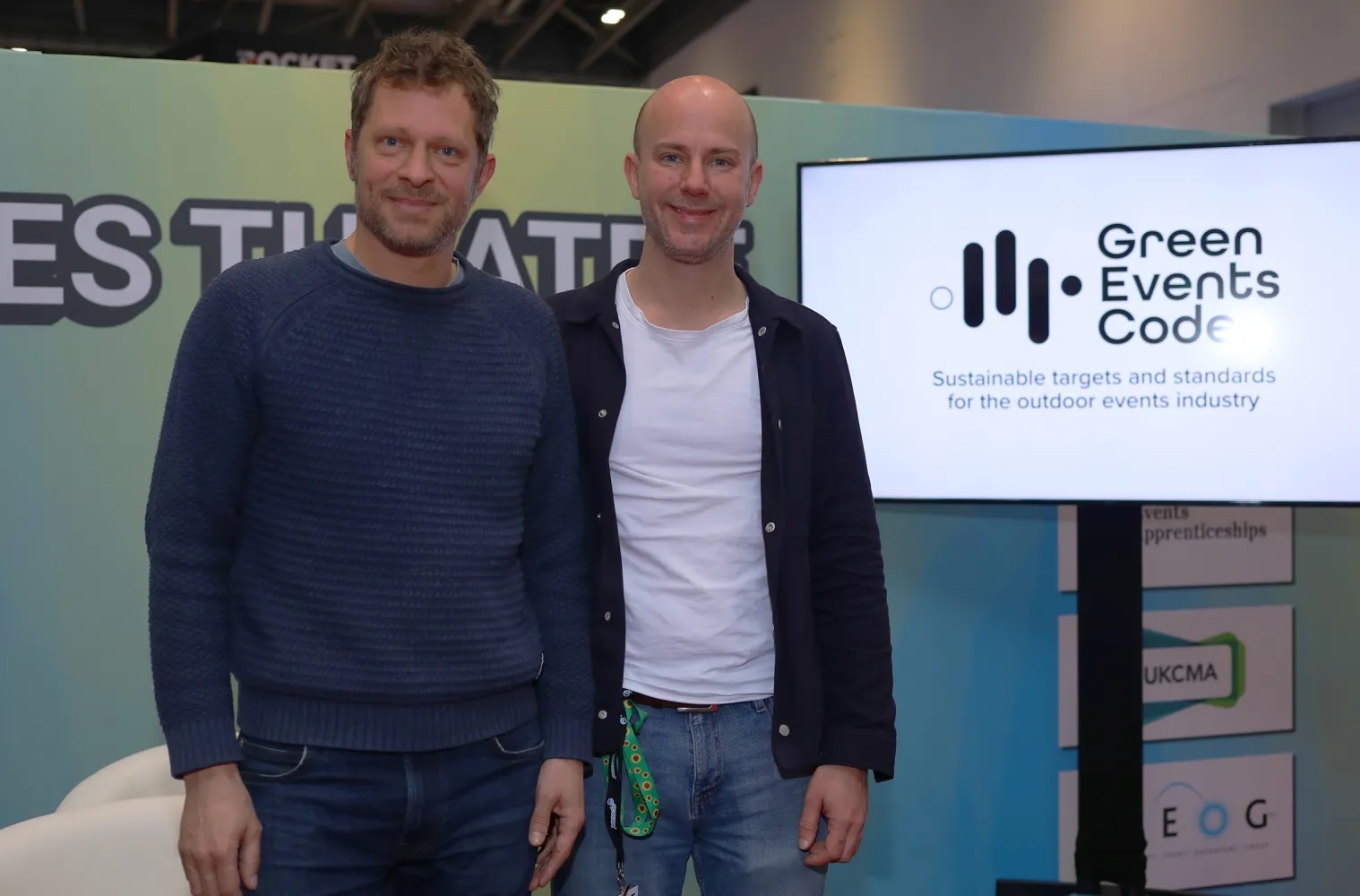
Andrew Lansley and Chris Johnson launch the Code at EPS
In January last year, a 12-month GECOP pilot was launched in collaboration with ten National local authorities including Manchester, Bristol and Reading, to test how GECOP can be used to embed sustainability within local authority processes.
The majority of the councils involved in the pilot have expressed a desire to continue using GECOP, while some 92% of the event operators that took part said they are more likely to implement new sustainability initiatives this year as a result of being involved in the GECOP assessment.
“The interest in the toolkit has been phenomenal.”
Lansley says the project has been a great success, with an overwhelmingly positive response from local authorities and event organisers, and the initiative has had an impact way beyond the National councils and events involved. While many local authorities, including Manchester City Council, have expressed interest in continuing with the project, the toolkit has also garnered interest from the international research community and a number of organisations, including a four-year EU funded project spanning 32 European countries.
“The interest in the toolkit has been phenomenal and demonstrates the value it holds for an industry without progression regulation in place,” says Lansley. “It has already been adopted widely with OutdoorArts UK, as well as being subject to additional deployment at WOMEX in Manchester as well as Eurosonic (ESNS) 2025 (pictured). I am currently in talks with several global organisations about expanding the application of the toolkit, but most of our efforts are going towards preparing to deliver our EU project and, we hope, Phase II of the GECOP pilot.”
ESNS sustainability coordinator Ron van Wegan says, “The tool gave us an opportunity to open conversations with our partner venues and create a connection between them that meant they could share information and support each other on their sustainability journeys. It also enabled us to accurately index their status on accessibility and environmental sustainability.”
Created with the aim of establishing a blueprint for legislation around environmental sustainability that works for the events, local authorities and the environment, Lansley compares GECOP to a Babel Fish, a fictional device imagined by Douglas Adams for his book The Hitchhikers Guide To The Galaxy – a small fish that once inserted into a human ear simultaneously translates from one spoken language to another.
“I am currently in talks with several global organisations.”
He explains, “GECOP has proven to be a point of translation between civic infrastructure and commercial and cultural events organisations, enabling discussion around enhanced sustainability standards. Where most event organisers used to go into SAG or license commission meetings, and there was this sitting across the table from each other dynamic, suddenly the dialogue switched to sourcing solutions together.
“Event organisers are very keen to be sustainable, that’s demanded by their audience. Meanwhile, 84% of local authorities have declared climate emergencies. There’s a shared problem, and by having those conversations it became a very productive way to address climate solutions together.”
Lansley says that what first excited him about GECOP was its accessibility: “The overwhelming majority of event organisers cannot afford expensive consultants or certification, yet they are keen and motivated to act. The Green Events Code of Practice empowers event managers to act on things themselves. That is also why councils are so excited. We found that the toolkit equipped local authorities with the facility to self-assess, and also make decisions based on scientifically led information.”
With the Events Industry Forum and Arts Council England-funded GECOP pilot now at an end, the next stage for Lansley, Vision for Sustainable Events’ Chris Johnson and Julie’s Bicycle’s Richard Phillips is to issue a report of the findings, gauge the industry’s response to that, and look at ways to fund the rollout of GECOP as an ongoing initiative.
Currently there is no funding in place for GECOP’s continuation, but Manchester Council is among those to have expressed interest in funding its continuation, while events including ESNS have integrated it into their reporting processes.
Says Lansley, “If we can find a way to fund the continuation of GECOP, directly from local authorities, then that will create an opportunity for them to control their own destinies in terms of how their events profiles look.”
“We are also hoping that we’ll gain some traction with government because a lot of this is aligned with its priorities, and I’ve been asked to share our findings by a number or parliamentary researchers and policy analysts with the UK government.”