

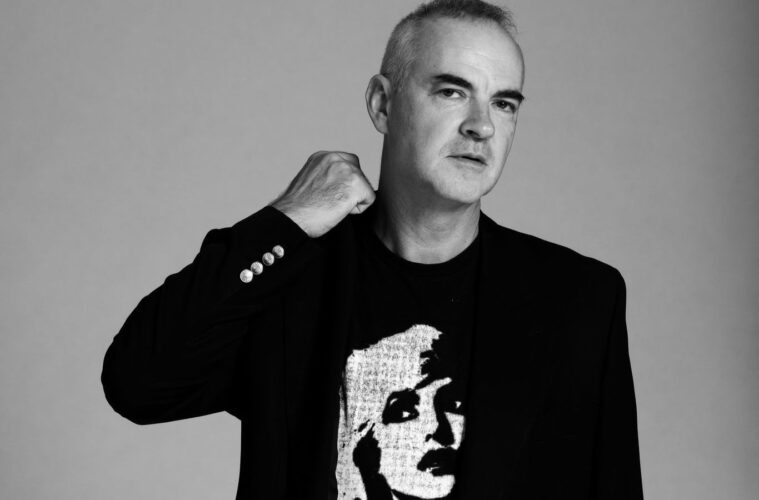
 Max Steventon
As Nouvelle Vague ready themselves for another UK tour starting tomorrow (12 November), its mastermind behind the music Marc Collin talks all things Nouvelle Vague, musical influences and why now is the time to start touring again.
How did Nouvelle Vague first come about?
It was a long time ago, more than 20 years now. I’ve always been a big fan of postpunk music. I used to love The Cure and New Order, bands that for me wrote the most beautiful songs and real classics for my generation.
I was fed up with people always talking about Elton John, The Beatles, and The Beach Boys. Of course they’re great, but I wanted to prove that bands coming out of punk, who maybe knew only two chords, could also write beautiful, timeless songs. I thought the best way to show that was to keep the skeleton of those songs, the lyrics and melody, and completely reinvent them.
I imagined those songs as if they had been written on a Brazilian beach in the 1950s, with a bossa nova sound. That idea of transforming postpunk into bossa nova was really the starting point for Nouvelle Vague.
How did you choose which songs to cover, especially on that first album?
For the first album it was actually very easy because it was all new and there was no pressure at all. We had absolutely no idea it would be successful. I was doing it mainly for myself because I wanted to listen to those songs in a new way.
Olivier, the guitar player, and I just sat down and picked songs. We said, of course, we should do Love Will Tear Us Apart. For The Clash, we decided on Guns of Brixton. I wanted to avoid being too obvious or just choosing the big hits. I knew fans of The Clash loved that song because it was darker and more intense.
There was such a huge catalogue of great material from that era. Honestly, we probably made the selection in an hour.
What music did you listen to growing up, before postpunk and bossa nova came into your life?
The first real passion I had for music was ska, the British ska scene. I discovered The Specials, The Selecter, and Madness. I loved everything about it, the black and white visuals, the rhythm, the energy.
At that time I had no idea ska was Jamaican music or that these British bands were covering Jamaican songs. I just loved it instinctively. I was probably 12 years old.
Then I subscribed to New Musical Express, which used to arrive by post, always a bit late, but it was amazing because I could read about all these new bands and practice my English. That was my first step into being a real music fan, not just a listener.
There’s such a unique mix of influences in Nouvelle Vague, from postpunk to Brazilian music and jazz. Is that blend what makes you stand out?
Yes, I think so. After my postpunk years, towards the end of the 1980s, I became more curious about other types of music. I was buying a lot of vinyl and exploring new sounds. One day I watched a documentary about bossa nova on French TV.
They translated the lyrics, and I suddenly realised how beautiful they were, poetic, subtle, intimate. It wasn’t just jazz or easy listening, it had depth. I became a fan of Brazilian music and later went to Rio, around 1995.
What struck me was that bossa nova wasn’t really everywhere in Rio at that time, but I realised the melancholy of that music connected deeply with postpunk. Both have sadness, beauty, and emotion. I thought that if you mixed those two worlds, something really special could happen.
How did the song In a Manner of Speaking come about?
That one was quite magical. We had worked with Tuxedomoon about six months before in Brussels. I already knew the band because I was a fan of the Crammed Discs label. When we decided to cover one of their songs, we asked Camille to sing it.
She just came into the studio and sang it once, and it was beautiful. We didn’t need to add anything. It became one of those moments where you realise something unique is happening. Now, twenty years later, it’s our biggest song. Everyone knows it as a Nouvelle Vague song, even though almost nobody knows the original.
How did you find your collaborators and singers?
In the beginning it was very simple. I had the concept in my head, which was really more of a producer’s idea than a musician’s idea. At that time, in 2003 or 2004, the sound of the 1980s was not trendy at all. Through the 1990s, everyone wanted to forget the 80s. It was all drum and bass, techno, and trip-hop. So in a way, we felt it was the right moment to bring that sound back in a completely different form.
I asked Olivier, my guitar player, to collaborate because he was a big fan of 80s postpunk. He knew all the songs, which made things easy. I wanted to find one Brazilian singer, but it was difficult. I found one, but she didn’t speak English, which made recording tough. That’s why the first song, Just Can’t Get Enough, has this cute accent and imperfect pronunciation, which I actually loved, but we couldn’t make a whole album like that.
So I started asking friends, singers I knew. I was already working with Camille on another project, and I’d received demo tapes from Mélanie Pain. I called them both and said, come by the studio, it’s easy, you just have to sing.
The amazing thing is that most of the singers didn’t know the original songs. They were in their twenties and had never heard of The Clash or Joy Division. We didn’t even play them the originals; we just gave them our arrangements and the lyrics. That kept everything fresh and gave the songs a new life.
You’re touring again now. Why was this the right time to get back on the road?
We never really stopped touring, but yes, in the early years we did huge tours, especially in the UK. Our first UK tour was on a tour bus for almost two months. We played big venues like the Roundhouse in London, and it was incredible.
After six albums, I felt we had said everything we needed to say, and it was starting to feel repetitive, so we took a break. Then the 20-year anniversary came up, and we thought, we have to do something. People suggested making a new album, and at first I wasn’t sure, but I started having ideas again.
We’re still on that anniversary tour now. We played in the UK recently and might go to Asia next year. That will probably be the end of the 20th anniversary tour.
Do you have a favourite venue in the UK?
We love playing in the UK because people know the songs and sing along. It’s much easier than playing in Germany or Italy, or even Asia, where the connection isn’t quite the same.
Playing at the Roundhouse in London was a dream. As a teenager, I used to read about all these live recordings from bands like Joy Division and New Order playing in places like that. When we played there, it felt mythical.
Our very first London concert was at the ICA. We also played La Scala, and in Manchester at a great club, though I can’t remember the name now. Liverpool was amazing too. We’ve played Bristol, Brighton, The Concorde, all beautiful venues. We definitely love playing in the UK.
What about new projects or ideas you’re working on now?
I’m not doing only Nouvelle Vague. I have two record labels, and I produce films as well. Nouvelle Vague remains a passion project for me. Sometimes I’ll hear an old song on the radio and think, oh yes, that one could be something for us.
Recently I recorded a whole Nouvelle Vague album in Rio with Brazilian musicians. It focuses entirely on the repertoire of Depeche Mode. It’s the first time we’ve made an album that centres on one single band but with different singers. It’s still in the works, but I’m very happy with it.
Choosing the songs is always a beautiful process. You go through so much material, and certain songs just resonate with you, often because of personal memories or the first time you ever heard them. I’m always thinking about what the next step could be.