

 Christopher Barrett
As the Southbank Centre prepares to host the Harry Styles curated Meltdown Festival, its head of contemporary music Jane Beese outlines how the event’s impact will be felt throughout the UK and discusses the wider plans to mark the centre’s 75th anniversary while staying true to the ambition and values of the 1951 Festival of Britain.
This month will see Harry Styles curate the 31st edition of Meltdown, following in the footsteps of the likes of David Bowie, Patti Smith, Chaka Khan and David Byrne. The festival will feature a lineup of acts including Styles, Kamasi Washington, Nilüfer Yanya and Jon Hopkins.
Meltdown forms part of the Southbank Centre’s 75th anniversary activity, and will run from 11–21 June spanning the 11-acre site that is home to the Royal Festival Hall (cap. 2,780), Queen Elizabeth Hall (915) and Purcell Room (293).
Here, Jane Beese outlines how both the Meltdown Festival and the wider birthday plans will involve a national programme of art, literature and music, with around 40 per cent of the events being free to attend. The aim is to reach one million people in more than 40 towns and cities across all four nations of the UK.
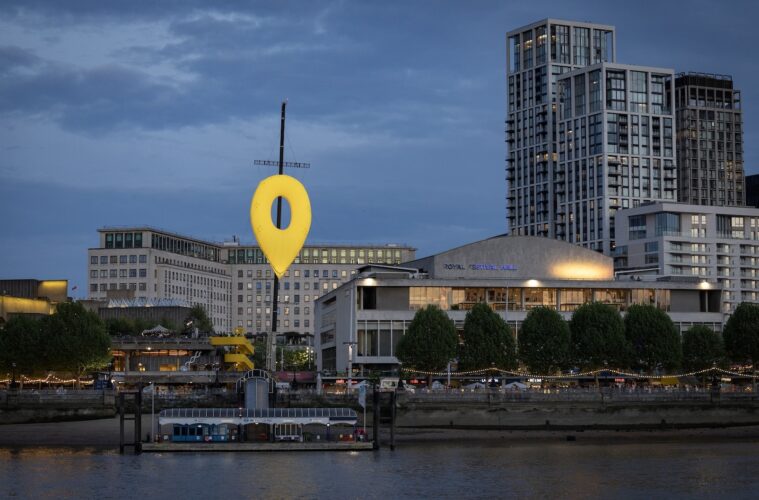
You launched the 75th anniversary activity in style with an eye-catching 20-metre-high Pin Drop activation suspended 20 metres from the ground (pictured). Is there a focus on keeping the optimistic spirit of the opening event, 1951’s Festival of Britain, alive at the Southbank Centre?
It is a big site and a big anniversary. Without being too nostalgic, we will be reflecting on an incredible 75-year-history of working with some of the most iconic artists in the world, while also looking back to the ethos, purpose and the spirit of the Festival of Britain. Back in 1951, people were recovering from the Second World War and everything was pretty grey but there was a lot of innovation in the Festival of Britain, and a lot of looking towards the future with optimism.
Back in the early 1950s, we were described as ‘London’s living room’, and that still makes perfect sense today. We do an awful lot of work with young people and emerging talent. More than 40% of what we do is free to attend.
What are the plans to mark the South Bank Centre’s anniversary this year across its 11-acre site and beyond?
There is a national focus to the programming. We are working on a project called Hometown Meltdown, where we’re doing Meltdown festivals in six towns across the country. We’re working in partnership with Music Venue Trust on that to enable curators to oversee show series in grassroots venues. We also have a project called A Poet in Every Port, which is run with the National Poetry Library. That will celebrate poetry in coastal communities across the UK.
At the Southbank Centre, we have a lot going on. There’s Harry’s Meltdown, the London Literature Festival curated by Dua Lipa, we’re doing a weekend with Rough Trade Records, we have Anish Kapoor in the Hayward Gallery, a podcast festival Goalhanger: the Rest is Fest, and then there’s Creative Intelligence; a big new festival focused on creativity and technology that starts in early September.
You first joined the Southbank Centre in 2000 before taking roles at the likes of Manchester International Festival and Roundhouse. How does it feel to be back, and what is your ambition when it comes to programming the venue?
The ambition is the same; to represent the best artists at every level. Since I left the Southbank Centre in 2015, the landscape has changed. It’s way more difficult now for young prospective artists to find their way. We’ve had decades of the decimation of music and art in state education, and the loss of youth clubs. That makes it really challenging for the next generation to work out where they can hone their craft. So, there’s a lot more of a focus on that at the Southbank Centre but, essentially, the ambition is the same; it’s about helping artists at every level and enabling interesting collaborations across art forms.
You recently joined the Music Venue Trust as a chair and are clearly passionate about supporting the grassroots sector. Is Hometown Meltdown an example of the way you are working that into your role at the Southbank Centre?
We have supported MVT since its inception. The first Venues Day was held at the Southbank Centre in the Purcell Room in 2014 and we had about 100 venues from all around the country. I specifically remember this one moment where somebody said, ‘I’ve just spent £5000 on a lawyer because of a resident complaint, and then somebody on the other side of the room said, ‘Oh, I’ve just spent £7000 on a lawyer for the same reason’. It was the start of creating a community that previously didn’t know it existed, because often running small venues can feel like a solitary experience. To go to Venues Day this year and see 350 venues from across the country come together to address common challenges was great to see.
We’re continuing to work very hard with MVT and are currently putting together Hometown Meltdown, which involves some really interesting artists and venues. We had a conversation last week where we spoke to three of the venue operators on back-to-back on calls. What was so extraordinary, challenging, and brilliant at the same time, was that those spaces work on totally different business models. It’s a really vibrant element of the industry, and the people who run those places are extraordinary.

Meltdown curator Harry Styles
At a time when Harry Styles’ 12 Wembley Stadium shows are expected to generate £1.1 billion for London’s economy, it’s pretty remarkable that you have got him curating a festival and performing at the Southbank Centre. How closely have you worked with Harry on the Meltdown Festival?
I’ve worked on the festival since 2001, which was with Robert Wyatt, but missed the years between 2015 and last year’s with Little Simz. In terms of the level of involvement, it is different every year. There are some people who give you a list and say ‘this is it, don’t deviate’, there are others who are less involved, and then there are people who are really collaborative and listen to suggestions from the team and I. With Harry, he had a very clear idea of the breadth of the work that he wanted to represent but he has also been collaborative and open to suggestions. He has been very involved.
Like all Meltdowns, it’s basically a chance to look into somebody’s record collection, which I love the idea of. There’s always interesting stuff that encourages audiences to be curious.