


 Christopher Barrett
From scanning for unexploded World War II bombs to building floating bridges, providing temporary accommodation for 15,000 military personnel and meeting strict sustainability targets, the teams involved in building the Paris 2024 Olympic Games all deserve a medal. Access goes behind with scenes to hear what was involved, and what the legacy will be for the wider events industry.
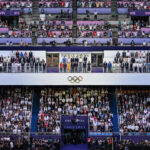
Paris 2024 provided no shortage of exhilarating sporting action during its 16 days, with 31 world records broken and France able to celebrate a home-grown hero in swimmer Leon March becoming its first athlete to win four individual golds at an Olympics.
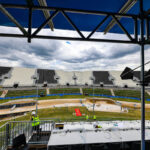
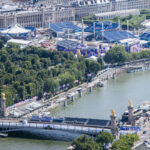
Aside from the sporting drama within the event’s 35 stadiums, what most impressed this visitor was the way in which the venues were interspersed throughout the city utilising some of its best-known and most beautiful sites to remarkable effect.
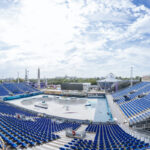
Among the many stunning constructions were the Eiffel Tower Stadium created in the shadow of the iconic iron tower, the Château de Versailles arena assembled in the stunning Etoile Royale esplanade, and the temporary infrastructure at Place de la Concorde that hosted breaking’s Olympic debut alongside the likes of BMX freestyle and skateboarding.
A key focus for the Paris 2024 Olympic Games organising committee was minimising the huge event’s environmental impact. The stated goal of making Paris the greenest Olympic Games ever staged, leaving half the carbon footprint of the London 2012 and Rio 2016 editions, was manifest in the huge number of temporary structures threaded between the city’s stunning historical landmarks.
Ten new permanent sites were constructed for Rio 2016, while London 2012 saw six built, but of the 35 venues that hosted events during Paris 2024 only two were new permanent facilities.
The vast number of temporary structures required for Paris 2024 presented a huge opportunity for overlay suppliers. They were called on to help meet the organising committee’s sustainability commitment to create the Olympic and Paralympic Games with 95% of its temporary infrastructure being re-used.
The focus on environmental sustainability was also very apparent, but on a smaller scale, in the Athletes Village, where plant-based food was prioritised, and furniture was created with everything from recycled shuttlecocks and bottle tops to parachute canvas.
-

- Michael Reaves/Getty Images
-
- Mahdi Aridj Photography

-
- Mahdi Aridj Photography
-
- MOHD RASFAN / AFP

Power play
Claiming that some 4 million litres of diesel was used to create electricity for London 2012, Paris 2024 director of environmental excellence Georgina Grenon emphasised that the focus for the French event would be on avoiding diesel generators at all costs, and connecting venues to the national electricity grid.
As an official partner of Paris 2024, GL events not only provided overlay planning and the delivery of around 70% of the event’s temporary infrastructure, with some 14 stadiums including the equestrian and para-equestrian event grandstands in the gardens of the Château de Versailles, GL also provided temporary power solutions.
GL events teamed with Loxam to become the prime contractor for the design, maintenance and operation of all electrical installations at Paris 2024. The focus was on enabling a “clean and reliable” power supply to more than 55 venues, including the Broadcast Centre.
 Maxime Rosenwald (pictured), the managing director of GL’s Live Division says the task involved providing temporary power not only to all of Paris 2024’s competition venues but also the non-competition facilities.
“We worked with the organising committee to use the utility power to bring electricity to all the Olympic venues, which involved us installing 8,000 distribution boards and laying more than 1,200km of cables. We did install some generators but only as a third backup. In case we had a failure of the main power supply from the utility, we had a second power supply, and if that failed only then would we turn on the generators.”
Rosenwald says that GL events handled the power distribution at FIFA World Cup at Qatar in 2022 but the provision for Paris 2024 was on another level: “The Olympics was the first time we have done the electrical distribution for an event of that scale. We have shown to the world that GL is able to deliver complex temporary power distribution to this kind of event, and that’s a big legacy for the company.”
That legacy reaches beyond GL’s French operation. GL’s UK CEO Scott Jameson (pictured right) says that the team at its Flow Power Solutions subsidiary, based in Stoke-on-Trent, sent equipment and people to project manage some of the installs.
“With GL being France based, a lot of it has been handled by the French team but it’s been good for the UK team to get involved and get experience of bigger projects like this,” he says.
The UK team’s involvement didn’t stop at power, with furniture supplied by GL event’s Xpect Furniture arm, and tents and structures provided from the UK for Versailles and army accommodation.
“We have invested a lot in new equipment, which will benefit UK events in the longer term,” says Jameson.
Overlay
GL events’ huge overlay provision for Paris 2024 involved 60 Olympic venues, and the instillation of 160,000 grandstand seats at stadia. It also worked on 25 “satellite” projects such the 100,000 square meters of structures needed to accommodate 15,000 military personnel.
Rosenwald says that among the many challenges was installing the 160,000 grandstand seats in the heart of Paris while trying to minimise the impact on traffic: “We tried to delay the closures of bridges and areas of the city to the latest possible moment to avoid a nightmare for the Parisian people,” he says.
Other transport related complexities came with building major structures for the first time on sites that had subway trains running underneath. “Much of Paris has a subway network underground, so we had to work closely with our engineering company and the subway operator to make sure there was no risk of collapse in the tunnels below,” he says.
At Versailles, the many challenges included working within the limitations of the historic house and gardens. Having excavated a huge amount of soil to create grandstands, it meant restoring the site exactly to its original state.
As if that wasn’t enough, World War II explosives came into play. Says Rosenwald, “Before we started, we had to have people with detectors check that we had no bombs from the Second World War, because apparently during World War II, the site saw some of the worst bombing.”
Another considerable challenge came with creating a purpose-built pontoon over Versailles’ historic Grand Canal to enable horses to gallop across it without it moving.
“We built a floating bridge that had to remain still even when a horse ran onto it as 60 kmph,” says Rosenwald. “It was a massive engineering challenge to ensure there was no movement that could scare the horses.”
Enter Arena
“It is probably the standout project we have done, globally, as a company.” – Arena Group CEO Paul Berger
As an official supporter of the Paris 2024 Olympic Games, Arena Group delivered infrastructure to no less than 90 Olympic venues across France, including 40,000m2 of structures, 75,000 seats, more than 1,000 bungalows and some 25,000m2 of trackway.
Among the many complex projects carried out by Arena Group was the transformation of the La Defense Arena in Nanterre from an indoor rugby and concert venue into the Olympic Aquatic Arena housing two swimming pools. Arena undertook the hugely complex task in less than seven weeks.
Arena worked in line with Paris 2024’s sustainability commitment to organise the Olympic and Paralympic Games with 95% of its temporary infrastructure being re-used. Among its many key projects was the design and delivery of bespoke TV studios at the Trocadero for broadcasters including the BBC.
 Arena Group CEO Paul Berger (pictured) says Paris 2024 was the largest overlay operation the company has ever taken on: “London 2012 was big, but Paris 2024 was more than twice the size of what we delivered in London.
“We have built some great events around the world, and we will continue to do that year in and year out, but what was so special about Paris was how our overlay teams, supported by our regional divisions, came together to deliver something that was incredibly complex.
“We are so proud to have been able to deliver such a complex and technical project across the multiple venues, not least considering the logistical side as well. I think it is probably the standout project that we have done, globally, as a company.”
For Arena Group, the Paris 2024 journey started nearly two years before the opening ceremony lit up the Seine. With a year and a half to go it set up an office in Paris, at first it housed a team of a just few people but by the start of 2024 it had grown to nearly 100.
Berger says, “We deliberately made sure that our office in Paris was around the corner from the organising committee headquarters so that we could be with them on a regular basis. Our level of communication with them was extremely good, it really felt like a partnership.”
Arena Group also opened its ‘Arena House’ as a meeting point in the city for networking and hospitality provision. Says Berger, “We wanted to leverage our engagement with Paris 2024, and particularly in overlay, so we used the house to host visiting delegations from all over the world, including friends of the company, suppliers, and employees, to thank them and acknowledge their efforts. It proved to be a huge success, the number of visitors we had on a daily basis was remarkable.”
With so much money, time, product development and technical expertise having been invested in the Paris 2024 project, Berger says there will be a lasting Olympic legacy for his company.
“It is not just about coming to Paris and delivering 14 competition venues, 75,000 seats and 40,000m2 of structures. We have invested in structures, we’ve invested in fencing, we’ve invested in flooring, we’ve invested in new seats as well. All of that will go into our regions where it will be reused again and again at major global events.
“We are very much, as a business, invested in overlay and we’re taking it seriously with a dedicated team.”
Global impact
Another key official supporter of Paris 2024, ES Global was heavily involved in the Olympic and Paralympic Games working across no less than 57 sites, most of them competition venues but also non-competition sites such as the Olympic Village and training facilities.
The company provided three different strands of overlay; tents, containment, and scaffold structures. While its containment work involved providing cable protection, above and below ground, ES Global’s scaffold structures ranged from camera platforms to the presidential box and the Régie Annexe control room at Stade de France, as well as the climbing walls at the Le Bourget Sports Climbing Venue.
 ES Global joint CEO and founder Jeff Burke (pictured) says that its involvement with Paris 2024 was the result of a company strategy to focus heavily on major events, build a local presence well in advance in the host city, invest heavily in the bid, win it, and then maintain a strong presence in the territory for years to come. He uses the 2020 Tokyo Olympics as an example, with ES Global having set up in Japan ahead of the Games, and now having a business there boasting a turnover of more than £100 million.
“It’s been one of the most challenging projects we have worked on.” – ES Global joint CEO and founder Jeff Burke
In the case of Paris 2024, the first meeting ES Global had with its organisers was way back in 2021. With the work now complete, Burke says LS Global will maintain the Paris office as its European headquarters from which it will look to win major contracts with events including the 2026 Milano Cortina Winter Olympics and the French Alps 2030 Winter Olympics. The French HQ is headed up by the company’s European general manager Cyrille d’Estienne d’Orves.
“That strategy has worked really well and now we’re repeating that in France and wider Europe,” says Burke. “As a touring company, Brexit impacts us greatly, and so this is one of our key mitigation measures.”
At the outset, ES Global stated it would reuse 90% of overlay items in its Paris 2024 delivery, with the rest either upcycled or recycled. Burke says that the full sustainability report is yet to be produced but he is confident the result will be very close to the target figure not least because the equipment used is modular and the material recyclable: “When you’re reusing 100% of the equipment and you’re keeping it in packaging that’s reused it’s very difficult to find waste. If something does gets damaged, it gets recycled. We’re using steel, which is a very recyclable material.
“My job is to convince the next user of the kit to do as little to it as possible in terms of adaptations to get the best return, both in terms of sustainable legacy and cash, because it’s going to be cheaper for them.”
With the Paris 2024 production using multiple public and historic buildings in the centre of the city to dramatic effect, the logistical challenges were far greater for suppliers than at other previous Olympic Games where much of the action took place in and around purpose-built longterm venues.
Says d’Estienne d’Orves, “Obviously the challenge was to mount, and then dismantle all these structures in places where normally pedestrians, vehicles and businesses operate daily. It was very challenging from an access point of view, with some sites delivered in phases, because it wasn’t possible to close off the whole area.”
He says the experience gained delivering such a challenging event will pay dividends in future projects across Europe: “It has impacted the way we approach Milan Cortina, which we’re beginning to tender for, because we learned a lot of lessons in Paris.”
Burke says he is incredibly proud of his team’s Olympian performance throughout the whole process; from tender to winning it, design through to delivery: “It’s been one of the most challenging projects that we have worked on, for all sorts of reasons, but the patience the team demonstrated has led us to a very successful outcome.”
Home zones
Meanwhile, fans back in Britain were able to get a taste of the Olympic atmosphere by congregating at nine Team GB Olympic Fanzones in cities including Edinburgh, Bristol, Manchester, Liverpool and London. However, with Britain battered by riots and thunderstorms, there was no shortage of threats to consider for the events teams.
We Are Placemaking produced the Fanzone in London’s Grosvenor Square, where visitors could get a drink from the al fresco bar before sinking into a deck chair to watch the sporting action on a giant outdoor screen.
Senior event producer Will Garner says the project was the latest in a long-lasting relationship with Mayfair London, and the activation saw around 8,000 visitors per day.
Production elements included bar and seating infrastructure, power and distribution, fencing, matting, toilets and flooring, lighting, wi-fi for traders and production, and water for guests.
“We also had security and medical presence throughout the event,” says Garner. “It required a four-month advancing period, before our production and health & safety coordinators headed on site for the 24-day-long build, live and break period.”
When it came to the inclement weather and threats of violent protests, Garner says the team were well prepared for all eventualities: “We evacuated the site to protect guests from the weather, liaised with protestors to ensure the event was not disrupted, and worked with the emergency services to manage riot risks in surrounding areas.
“In the end it was just a quintessential summer viewing party that everyone really enjoyed.”
THIS ARTICLE IS INCLUDED IN THE AUTUMN EDITION OF ACCESS ALL AREAS – SEE HERE