

 Christopher Barrett
On the back of him winning the AAA Editor’s Award, London Marathon Events CEO Hugh Brasher talks us through the company’s international expansion, the focus on driving increased diversity at its events, and plans for the 50th anniversary of the London Marathon.
Last year’s TCS London Marathon set a new world record for the largest single-day fundraising event, with the £87.3 million generated bringing the cumulative amount raised since the events’ inception to £1.4 billion.
London Marathon not only raised a staggering amount of money in 2025 but also set a world record for the largest number of marathon finishers, with 56,640 crossing the line.
Hugh Brasher
With more than 1.1 million people having entered the ballot for this year’s London Marathon, it’s clear the public’s appetite to take part remains insatiable. At London Marathon Events (LME), there are plans to build on that momentum in the lead up to the 50th anniversary of its headline event.
At the heart of those plans is a strategy to inspire activity throughout the UK, and recent years have seen LME buy into events companies throughout Britain.
In late 2022 LME took over the Brighton Marathon following the collapse of its former operator, Grounded Events Company. Shortly after that it acquired a 50% interest in Run 4 Wales, the operators of multiple events including the Cardiff Half Marathon. The following year LME bought Loch Ness Marathon-owner Caledonian Concepts, and among its most recent investments was Friday Night Lights – a burgeoning UK-wide operation that creates events which combine running with music and social activities.
LME CEO Hugh Brasher says there are now plans afoot to build on LME’s recent acquisitions in the UK with deals in mainland Europe and the US. In the meantime, the UK acquisitions are enabling an evolution, not only in the events it is creating but also the way they are produced.
In 2024, LME acquired a majority shareholding in trail running specialist Maverick Race. As a result, it is staging a mixed trail and road version of the Brighton Marathon for the first time this year, which will see participants run 35km across the South Downs before merging with the traditional route for a 7km dash to finish in Hove.
“It is a matter of looking at how we can use the infrastructure that we’ve got and being as cost effective as possible by adding shoulder events to existing ones,” say Brasher. “We all know it’s the initial costs that are very, very, high for an event. By using existing infrastructure, we can reduce them.”
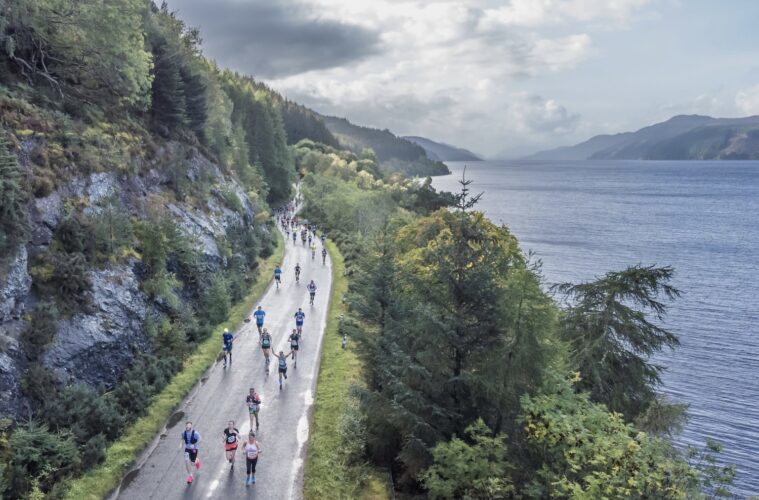
The extended reach of LME is also set to result in changes and enhancements to other longstanding events including the Loch Ness Marathon. With stunning views of the world-famous home of a certain mythical monster, the September event attracts around 10,000 runners to race in the Highlands each year.
“At LME we have an expansive mindset, and there is a lot we can do to benefit existing events,” says Brasher. “The Loch Ness Marathon is held in a truly beautiful area of heather moorland above Loch Ness, through which you run 26.2 miles into Inverness. But the amount of people watching is relatively small. We can boost that number and get the event sold out quicker. For this year’s London Marathon, certain participants will be offered the opportunity to enter the Loch Ness Marathon. The London Marathon is a global brand, so we have an opportunity to put the Loch Ness Marathon in front of runners from around the world and boost tourism and the local economy. It’s got to be responsible tourism; with these beautiful places you must be really careful; it needs to be sustainable for the local population and the beautiful environment.”
At the other end of the UK, Brasher says the London Marathon will also benefit from LME’s expanded portfolio: “Friday Night Lights will stage a new event this year; TCS London Marathon at Friday Night Lights. On the Friday night before the London Marathon, in Battersea there will be 5,000 people running 5km with lights and music. That’s particularly focused on a younger market and will expand London Marathon’s impact.”
The focus on expanding the demographic diversity at LME events is not limited to the London Marathon. More than a third of UK applicants to the event were aged under 30 last year, while more than half were women, according to Brasher – who says ethnic diversity is also a major focus.
“Hamid Vaghefian, who is the communities and DEI director, came into LME in 2017 specifically to work on The Big Half. We wanted to create an event that truly represented the amazing diversity of London. That event is already the most diverse mass participation running event in the UK, with 28% of the runners being ethnically diverse last year. In 2026 it is likely that will rise to 38%. That 10% increase stems from conscious decisions we’ve made, whether it is the tone of voice of the marketing or the event’s branding. It is showing that there is an opportunity to tap into a market that is currently underserved.”
That core focus to inspire activity is also resulting in a drive to grow the number of school children who get involved in the wider London Marathon event. Starting at Horse Guards Parade, the TCS Mini London Marathon will see 18,000 school children run up to 2.6km in the heart of the capital, with £10 donated to the school of each participant who completes the course.
“That is not only helping inspire kids to get active, but also building the future generation of people who will want to enter the London Marathon,” says Brasher. “They’re going to get this incredible feeling running on the same roads, and with an amazing medal at the end of the day, as the gods of the sport.”
The plan is to increase the number of participants in the Mini London Marathon from 18,000 to 50,000 by 2030, for the London Marathon’s 50th anniversary event. Brasher says Mini Marathon will play a significant role in a week-long series of London Marathon event activity involving an expanded entertainment offering and increased community engagement.
Says Brasher, “We’re looking at how we can get the whole of London active in 2030 across a full week, rather than usual three days, with elements including TCS London Marathon at Friday Night Lights. It is all part of a plan we have been executing in recent years to broaden the reach of our events and inspire everyone to get active.
“The average person who runs the London Marathon brings 4.4 people to watch them, and they each travel to 2.2 locations around the route. It means you have this movement of 260,000 people that we’re dealing with. We will work carefully with the London boroughs and the SAGs to make sure we provide an increased entertainment offering while enabling people to keep moving freely throughout the city.”
This article was first published in the latest edition of Access All Areas magazine.