

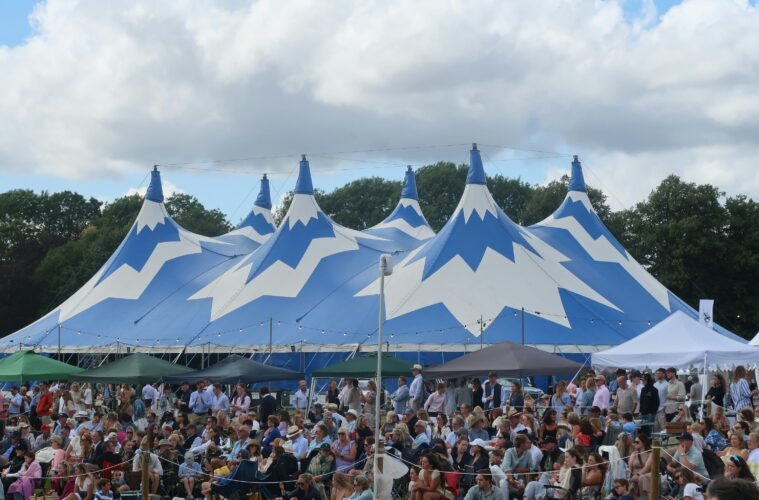
 Max Steventon
Rudi Enos, founder of Special Structures Lab and the Guild of TentMasters outlines how he is leading a push to professionalise the temporary structure sector.
According to Rudi Enos, the temporary structures industry is at a turning point. He says that for decades, expertise in erecting tents, marquees, stages, and other structures was passed down through apprenticeship and hands-on experience. Competence was measured by reputation, quality of work, and peer recognition, not formal credentials.
Here, the award-winning industry veteran outlines how the Guild is providing workers with a pathway to professionalism that combines formal assessment and certification with traditional craft knowledge to ensure they meet modern professional and legal standards.
Why is the certification so important to TentMasters and for the wider sector?
TentMasters is a not-for-profit organisation. It’s run by volunteers. We don’t have a professional secretariat, and because of the generosity of a few of our trade sponsors, we don’t have any membership fees this year. We’re here only to improve the breed. We are here to improve standards in an industry where there were and are, none.
TentMasters have been around for many, many years. It’s the oldest form of construction in history. But for some reason, there’s never been any training or qualifications for people putting tents up. Most events fall under the Construction Design and Management Regulations, CDM 2015, which state that you must have a competent person to sign off a temporary structure.
The problem is that people who put temporary structures up now have all the responsibility, but they don’t have the authority. That’s what we’re addressing. We’re not providing training courses ourselves; we’re offering certification and acting as a clarion call to the industry. We partner with organisations like ESITS and MUTA, who set the standards for the courses. Our role is to formalise competence where none existed before.
Why was this needed in the first place?
I’ve worked with some of the best tent masters, riggers and temporary construction people in the world. But it did occasionally really bug me that people would turn up who obviously hadn’t got a clue what they were doing, and they’re putting these structures up with 1,000 or 2,000 people inside them. You think, surely we can do better than this.
There have been failures and some pretty disastrous ones, particularly back in 13 years ago with Pukkelpop and Sugarland in America, with a stage falling on top of the audience. Who wants to be involved with something like that? I’ve been banging this drum since 1992. In this day and age, we need to prove our competency.
How has the industry reacted to certification and the white paper?
In 1992 the Guild was almost like a private club – big tents for raves, festivals and circuses. In 2012 we tried to formalise it because we’d seen what happened in the scaffold industry. Grandfather rights were stopped in scaffolding in 2015, and they do many of the same jobs as temporary structure crews.
We’re now getting 15 to 20 new members a week. We’re on the Event Industry Forum, we’ve partnered with MUTA. We’re working with major manufacturers like RÖDER, Arena, GL Events and Neptunus. We have people from those companies on our committees helping to introduce standards and approved codes of practice for each type of structure.
For the first time in 2025, we’ve had universal acceptance. People fought against this for years, thinking we were a trade association, which we’re not. This is individual membership only. This is no longer a train stopping at the station. It’s a snowball going down the mountain.
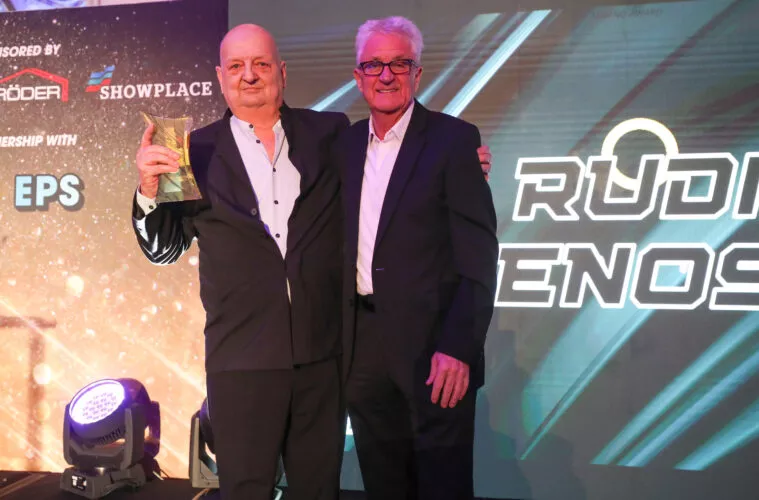
Rudi Enos (left) won the AAA Legend Award at the 2025 Event Production Awards
What skills and knowledge does the certification cover?
The minute you put a roof on a structure; the loadings change dramatically because of the increased wind area. A tent master has to be intimately aware of where those forces are and how they apply. They’ve got to understand transport, loading and handling, manual handling regulations, rigging, erection, maintenance, emergency protocols, and proper handover to the client because the minute you leave site, the client is in charge of the structure.
It covers such a wide area of expertise that not many people have all those skills, knowledge, and experience that the HSE is looking for. They look for industry benchmarks, ongoing training, quality documentation, proof of due diligence, and maintained records. There are dozens of things that go towards making a qualified tent master.
In addition to safety, will the certification help improve quality?
Absolutely it improves quality. When I started building festival stages, they were scaffold towers with lorry tarpaulins for cover. Big tents were white flower tents with forests of poles inside so you couldn’t see anything. Now you’ve got clear spans, clear sightlines, 40–50 metre structures, and the ability to hang 20 tonnes from the roof. Design, usability and professionalism have all improved massively, and this certification supports that evolution.
Do commercial pressures affect standards?
There have been issues where people cut corners, yes. But it’s not just commercial it’s knowledge. Nobody wants to write a letter to somebody’s parents explaining why their children didn’t go home. That question has stayed with me ever since Pukklepop.
What is the ESCA (Event Structures Command Authority) convention?
The TentMaster holds unilateral authority over structural safety. That authority cannot be overruled by promoters, event organisers, commercial stakeholders, or the tent master’s own employer. No disciplinary action or contractual penalty may be levied against a tent master for exercising their authority to halt work or evacuate a structure in the interests of safety.
This isn’t new. CDM already asks for this. We’re just formalising it.
How does the certification work now and what changes in the near future?
At the moment, we allow grandfather rights. If you can prove competence through previous jobs and employer or client references, we award a Certificate of Professional Competence. All you have to do is fill in a simple form on www.tentmasters.org listing your work experience and a certificate is awarded. If you don’t have the provable experience, don’t apply.
On 1 January 2027, that ends. From then on, it will be a formal two-stage qualification. The first part will be an ESITS general event management course. The second part will be a technical course we’re developing with academic partners, possibly including a University in Germany. This is not about turning TentMasters into structural engineers. It’s about making them aware of the physical principles involved.
How do you see this developing in the next five to ten years?
Within five years, everyone putting large structures up will have a TentMaster qualification. We’re introducing approved codes of practice for stretch tents, big tops, frame tents, and temporary roof structures. We’ve got a new app coming where tent masters can upload their safety documentation and show it instantly on site.
All of this sits squarely within CDM 2015 and British standards. We’re not asking for anything more than what the government already requires. This is happening. It’s just a question of how fast.